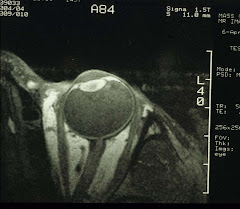
In a recent study, Stanford scientists were able to coax cells in damaged optic nerve to re-grow towards the brain, 200 out of 50,000 damaged cells (here). It was a combination of gene therapy and high-contrast visual stimulation.
Application to glaucomatous humans? A long shot at best.
Tuesday, July 19, 2016


Tuesday, May 10, 2016
"Flower" cataracts?

"...it's still not clear why these opaque regions take on certain shapes..."
But this is a case of sutural cataracts, of traumatic origin. No mysteries here.
Tuesday, December 22, 2015
X-ray vision
"A group of researchers led by Massachusetts Institute of Technology professor Dina Katabi has developed software that uses variations in radio signals to recognize human silhouettes through walls and track their movements."
This is based on disturbance to wifi field that can be detected with a smartphone.
Well-done.
This is based on disturbance to wifi field that can be detected with a smartphone.
Well-done.
Monday, November 30, 2015
Ocular Ebola
Surprisingly, Ebola virus lingers in the eye - more precisely, in the aqueous humor, most likely released from surrounding tissues.
Two cases in the US are now documented:
",,,But about two weeks after he was released from the hospital, [Richard] Sacra reported vision loss, pain, redness and sensitivity to light in his left eye. An examination showed a slight swelling of his cornea, and there were white blood cells in the space between the outer covering and the iris in his eye, the report said. Sacra was given a topical corticosteroid to apply to his eye every hour while he was awake.
"But Sacra's vision worsened, and he was given an oral corticosteroid, called prednisone. Within a week, his condition improved, and by March 2015, he had no symptoms and had 20-20 vision, the report said."
"Another American Ebola survivor, Dr. Ian Crozier, also had serious eye problems after he was declared Ebola-free, including blurry vision, pain and pressure in his left eye. At one point, his eye even changed color, from blue to green."
Two cases in the US are now documented:
",,,But about two weeks after he was released from the hospital, [Richard] Sacra reported vision loss, pain, redness and sensitivity to light in his left eye. An examination showed a slight swelling of his cornea, and there were white blood cells in the space between the outer covering and the iris in his eye, the report said. Sacra was given a topical corticosteroid to apply to his eye every hour while he was awake.
"But Sacra's vision worsened, and he was given an oral corticosteroid, called prednisone. Within a week, his condition improved, and by March 2015, he had no symptoms and had 20-20 vision, the report said."
"Another American Ebola survivor, Dr. Ian Crozier, also had serious eye problems after he was declared Ebola-free, including blurry vision, pain and pressure in his left eye. At one point, his eye even changed color, from blue to green."
Thursday, July 23, 2015
Lanosterol
News today: "...scientists analyzed the genes of two related families that both often suffered cataracts from birth.
"The researchers discovered that these families carried mutations in a gene involved in manufacturing a small molecule known as lanosterol. Normal versions of lanosterol in healthy eyes help prevent the kind of protein clumping that leads to cataracts, while the abnormal version seen in both families did not.
"To examine what effects lanosterol might have on cataracts, scientists experimented on dogs with naturally occurring cataracts.
"After six weeks of treatment with lanosterol eyedrops, lens cloudiness and cataract size decreased in the dogs. Similar results were seen in experiments with human lens cells and rabbit lenses on lab dishes. "
Too good to be true? Perhaps. Stay tuned.
"The researchers discovered that these families carried mutations in a gene involved in manufacturing a small molecule known as lanosterol. Normal versions of lanosterol in healthy eyes help prevent the kind of protein clumping that leads to cataracts, while the abnormal version seen in both families did not.
"To examine what effects lanosterol might have on cataracts, scientists experimented on dogs with naturally occurring cataracts.
"After six weeks of treatment with lanosterol eyedrops, lens cloudiness and cataract size decreased in the dogs. Similar results were seen in experiments with human lens cells and rabbit lenses on lab dishes. "
Too good to be true? Perhaps. Stay tuned.
Saturday, May 23, 2015
Prosopometamorphopsia
Prosopometamorphopsia: a psychiatric condition that affects perception of faces.
 A 52-year-old woman whose rare condition was reported in The Lancet suffered from hallucinations that caused her to see human faces as dragons.
The unidentified patient’s hallucinations were brought under control after she was prescribed rivastigmine, an anti-dementia medication.

The unidentified patient’s hallucinations were brought under control after she was prescribed rivastigmine, an anti-dementia medication.
Tuesday, April 21, 2015
Too much Vitamin A?
Yahoo Health 4/21/2015: "Warning: Too Many Dietary Supplements May Increase Cancer Risk"
"One trial showed that taking more than the required amounts of beta-carotene— which is known for its ability to improve immunity and enhance vision — in supplement form increased the risk for developing both lung cancer and heart disease by 20 percent."
“More specifically, taking more than the recommended daily allowance of folic acid, Vitamin E and beta-carotene were all shown to increase cancer risk.”
"If you take vitamins or other dietary supplements, choose products that stay within the recommended daily allowance.”
"One trial showed that taking more than the required amounts of beta-carotene— which is known for its ability to improve immunity and enhance vision — in supplement form increased the risk for developing both lung cancer and heart disease by 20 percent."
“More specifically, taking more than the recommended daily allowance of folic acid, Vitamin E and beta-carotene were all shown to increase cancer risk.”
"If you take vitamins or other dietary supplements, choose products that stay within the recommended daily allowance.”
Tuesday, March 31, 2015
Antibiotics for MRSA

"A 1,000-year-old Anglo-Saxon remedy for eye infections has been found to be effective against antibiotic-resistant superbugs, researchers from the University of Nottingham said on Monday. The scientists recreated a 9th Century remedy to treat styes.
"The age-old remedy called for "cropleek and garlic, of both equal quantities, pound them well together … take wine and bullocks gall, mix with the leek … let it stand nine days in the brass vessel," according to the New Scientist."
So far, it works on MRSA-infected mice.
Thursday, August 14, 2014
Printed eyes

Thursday, July 10, 2014
FingerReader

The so-called FingerReader, a prototype produced by a 3-D printer, fits like a ring on the user’s finger, equipped with a small camera that scans text. A synthesized voice reads words aloud, quickly translating books, restaurant menus and other needed materials for daily living, especially away from home or office.
The opposing view? Here:
The road to hell is paved with good intentions. Do the blind really want an audio reader? Most non-blind or hearing impaired do not understand the culture that lies in these communities, and are treated with a parental nurturing philosophy that borders on being totally insensitive to the needs of these communities. Did any one of these Samaritans ever ask the blind if they even want this. As far as I know most blind would prefer to read from a brail [sic] book, their second choice is an audio reader. When it comes to brail [sic] it is hard to create a page with a large array of dimples that would allow the blind freedom of reading (books, newsprint and leaflets). The visual impaired have a greater tactual sensitivity than all sighted people could never have, not understanding this aspect of their lives means not understanding the community you are trying to aid.
As far as computers is concerned, they have their own text to audio readers; which just needs to be switched on.
Wednesday, June 11, 2014
Mini-retina

The study is an important technical feat in using reprogrammed cells [i.e., iPS cells], whose discovery in 2006 [in Japan] has unleashed huge interest, they said.
“We have basically created a miniature human retina in a dish that not only has the architectural organization of the retina but also has the ability to sense light,” said Valeria Canto-Soler of Johns Hopkins University School of Medicine, Baltimore.
“Is our lab retina capable of producing a visual signal that the brain can interpret into an image? Probably not, but this is a good start,” Canto-Solder said in a press release.
Friday, February 7, 2014
When buying fish

Cloudy eyes = cloudy corneas = corneal edema = dead endothelium
Yep, not fresh enough for people with more sensitive palate.
Fish covered with ice, not on ice, are rarely dehydrated. Those with sunken eyes probably smell too fishy already, they should be avoided indeed.
Thursday, January 23, 2014
GlassesOff app
 |
| http://www.glassesoff.com/ |
Source: here
Friday, January 17, 2014
Google contact lens

Google is developing smart contact lenses that measure the glucose levels in diabetics' tears.
Comment: All contact lenses have the potential of impeding corneal access to air/oxygen. This changes glucose metabolism big time. Also, the tear turnover rate may vary from individual to individual. Much remains to be done before this smart lens becomes practical.
Saturday, January 11, 2014
A protein safeguards against cataracts
 |
It is this trigger mechanism that the team headed by Buchner and Weinkauf uncovered now. When a cell is exposed to stress, for instance when subjected to heat, phosphate groups are attached to a specific region of the protein. The negative charges of these phosphates break the links between the subunits and the large complexes consequently disintegrate into numerous smaller ones of only six or twelve subunits each. As a result of this breakup, the regions at the ends of the complexes become more flexible allowing the molecules to dock up with different partners, thereby preventing them from clumping – the protective protein is now active.
Source: here
Thursday, January 9, 2014
Bioflourescence in fish
A new discovery reported on 1/8/2014:
 "...a
variety of fish living around coral reefs -- including sharks, rays,
eels and lizerdfishes -- that exhibited bioflourescence [under blue light].
"...a
variety of fish living around coral reefs -- including sharks, rays,
eels and lizerdfishes -- that exhibited bioflourescence [under blue light].
"So how do the fish recognize it? Many of them have yellow filters in their eyes, "possibly allowing them to see the otherwise hidden fluorescent displays taking place in the water," a news release from the museum of natural history said.
However,
"...the need for special technology to view what the website called weak fluorescence "casts doubt on the usefulness of the coloration in the fish's dimly lit natural environments."
"So how do the fish recognize it? Many of them have yellow filters in their eyes, "possibly allowing them to see the otherwise hidden fluorescent displays taking place in the water," a news release from the museum of natural history said.
However,
"...the need for special technology to view what the website called weak fluorescence "casts doubt on the usefulness of the coloration in the fish's dimly lit natural environments."
[Source: CNN.com]
Tuesday, October 8, 2013
Nobel prize in physics 2013
(CNN ) - The Higgs boson, or the "God particle," which was discovered last year, garnered two physicists the Nobel Prize in physics on Tuesday, but it didn't go to the scientists who detected it.
Nearly 50 years ago, Francois Englert of Belgium and Peter Higgs of the United Kingdom had the foresight to predict that the particle existed.
Now, the octogenarian pair share the Nobel Prize in physics in recognition of a theoretical brilliance that was vindicated by the particle's discovery last year.
Well deserved. Congrats!!
Nearly 50 years ago, Francois Englert of Belgium and Peter Higgs of the United Kingdom had the foresight to predict that the particle existed.
Now, the octogenarian pair share the Nobel Prize in physics in recognition of a theoretical brilliance that was vindicated by the particle's discovery last year.
Well deserved. Congrats!!
Thursday, August 1, 2013
AMD stem cell trial began
World's 1st iPS cell clinical study for regeneration of retina begins
TOKYO — 8/1/2013The world’s first clinical study using stem cells harvested from a patient’s own body began Thursday. A government committee last month approved proposals for the tests, which will be jointly conducted by the Riken Center for Developmental Biology and the Institute of Biomedical Research and Innovation (IBRI) Hospital in Kobe.
Health Minister Norihisa Tamura signed off on a proposal by two research institutes that will allow them to begin tests aimed at treating age-related macular degeneration (AMD), a common medical condition that causes blindness in older people, using “induced Pluripotent Stem (iPS) cells”.
Sunday, February 17, 2013
Stem cell treatment for AMD

This is what a patient with age-related macular degeneration (ARMD) sees.
News on 2/17/2013:
TOKYO — Researchers in Japan have moved one step closer to clinical trials using adult stem cells in a therapy they hope will prove a cure for common sight problems.
The ethics committee at the Institute for Biomedical Research and Innovation in Kobe, last Wednesday approved a trial treatment for age-related macular degeneration (AMD) using induced Pluripotent Stem (iPS) cells.
The trial is aimed at creating retinal cells that can be transplanted into the eyes of patients suffering from AMD, a presently incurable disease that affects mostly middle-aged and older people and can lead to blindness.
Stem cell treatment vs artificial retina implant: the race is now on.
Friday, February 15, 2013
Artificial retina

[The Argus II device consists of special glasses outfitted with a video camera and a video processing unit that sends signals to a wireless receiver implanted in the eye.]
It took USD 200 million and 14 years for Second Sight Medical Products Inc of Sylmar, CA, to out-compete others and become the first to gain FDA approval for its artificial retina.
This is a good start. Indeed, much higher resolution is still needed, for one thing. The company plans to keep improving the treatment, which they hope will ultimately be used to treat age-related macular degeneration. For now, there are limitations:
(1) The FDA approved the system as a humanitarian use device, an approval that is limited to fewer than 4,000 people in the United States each year.
(2) The device is limited to adults 25 or older, with severe to profound retinitis pigmentosa who have no light perception or bare light perception, in which they can perceive light but cannot tell where it is coming from.
(3) The system will cost more than $100,000 when it is launched in the United States. And
(4) Although it does not completely restore vision, the implant helps with daily activities, such as locating objects and recognizing large letters and shapes.
[Sources: FoxNews and UDN News]
Subscribe to:
Posts (Atom)