Saturday, August 23, 2008
Monday, August 11, 2008
9.4 Valsalva retinopathy
event at Beijing 2008 Olympic Games, Aug 11, 2008.
Chen Xiexia (C) of China, Sibel Ozkan (L) of Turkey and Chen Wei-Ling (R) of Chinese Taipei wave to spectators at the awarding ceremony of the women's 48kg of weightlifting event at Beijing 2008 Olympic Games at the Beijing University of Aeronautics & Astronautics Gymnasium in Beijing, China, Aug 9, 2008. Chen Xiexia, Sibel Ozkan and Chen Wei-Ling won the gold, silver and bronze medals respectively. (From news/xinhuanet.com)Weight-lifting can injure the eyes. No kidding.
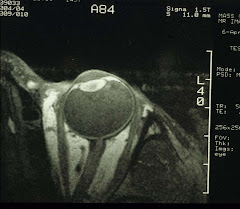
Once a patient came in and complained that his vision in the right eye was suddenly lost when he tried to lift some heavy boxes in his basement. Valsalva retinal hemorrhage immediately comes to mind. However, fundus exam reveals a cellophane membrane over a "wrinkled" macula. A macular pucker, it turned out to be. This is entirely different from the first suspect which occurs when one holds breath performing physically strenuous tasks, e.g., heavy weight-lifting, giving birth, passing stool, etc. The increase in the intrathoracic/abdominal pressure raises the venous pressure which in turn causes rupture of retinal capillaries. The blood accumulates between the retina and the vitreous. And vision changes if the hemorrhages occur within the visual axis. Often the history and a retinal exam confirm the diagnosis:
The above is an unusually large pre-retinal hemorrhage in a case of Valsalva retinopathy. More common than not, the hemorrhages are much smaller of about 1 disc diameter often found near the disc itself; although they can extend into the macula and obscure vision.
Luckily, most cases of simple Valsalva retinopathy heal quickly, spontaneously, and completely. Some cases, usually those with pre-existing vascular disorders, may require the Nd:YAG laser/surgical intervention.
So who/why/what is "Valsalva"? Well, Mr Antonio Maria Valsalva (1666-1723) was an Italian physician specializing in ear anatomy. He had also described the (original) Valsalva maneuver (i.e., what happens physiologically when you forcibly exhale against a closed glottis). He also coined the term, the Eustachian tube (which connects the middle ear and the pharynx). When you travel by air, when the airplane descends for landing, your ears tend to "pop". The reason is the rapid increase in the atmospheric pressure causes the Eustachian tube to collapse (or become pinched). Gum-chewing works the best in opening this tube and restoring the pressure balance. If you don't have any chewing gums handy, try opening your jaws with the lips closed instead.
Friday, August 8, 2008
Saturday, August 2, 2008
9.3 Centrifuges and reading in space
This is a standard desktop centrifuge. Each "hole" accommodates an Eppendorf centrifuge tube. The centrifugal force is about 2,000 x g, strong enough for separating most particulate matters from the solvents. For comparison, 1 x g is what most of us experience on the surface of Earth everyday.
Humans occasionally subject themselves to higher Gs. For example, most rides in amusement/theme parks are actually centrifuges or variations of centrifuges. While most are in the less than 2 x g range (an example is shown below), some in the form of roller-coasters, e.g., the Space Mountain in Disney World, can reach 4 x g.
Momentary exposure to 4 x g (or even higher) is relatively harmless, unless there is an undiagnosed pre-existing medical condition - then it can end in tragedy. Indeed, heart attacks and brain hemorrhages are known to occur on some high-G rides.
NASA has the ultimate centrifuge for the humans:
This is NASA's 20 x g centrifuge used for testing the physiologic responses of astronauts. And this is where you see the astronauts' faces start to melt, among other things.
Technically, the g-force is calculated thus:
where g = Relative centrifugal force (RCF)
r = rotational radius (centimeters, cm)
N = rotating speed (revolutions per minute, rpm)
Of course, g is also the basic unit of the gravitational force. Without gravity (i.e., zero-g), as that in the outer space, some human reflexes that have worked previously now begin to unravel. And one of them is the simple vestibulo-ocular reflex (VOR).
Now pick one object in your room, stare at it, and then move/rotate your head to left and right, you'll notice the object remains in the same stable position. In other words, the image of the object is stabilized on your retina. This is the VOR at work.
The sensory aspect of VOR is handled in the inner ear by the semicircular canals (which sense angular acceleration to detect head rotation) and the otolith organs (which sense linear acceleration to detect both head translation and the position of the head relative to gravity). The information is processed centrally and the output sent to extraocular muscles.
In zero-G, the semicircular canals do not work well because the fluid contained within no longer convects effectively. So the coordination between head motion and eye movement is now disturbed. If you read too fast, the text lines will appear jerky. Effective reading can be achieved only at voice speed. Whether VOR eventually adapts to long periods of zero-G and normalizes is still yet to be tested. In a long journey to other galaxies, catching up on your reading will become an integral part of mental exercise. Certainly beats looking out of the window into darkness 24/7.
Of course, large centrifuges can be incorporated into space stations and star ships. The centrifugal force will provide simulated gravitation that can make the astronauts' lives easier.
The (presumably) rotating space station shown below is in 3D. You'll need to borrow a pair of red-green glasses from your eye doctor to see the effect.
Humans occasionally subject themselves to higher Gs. For example, most rides in amusement/theme parks are actually centrifuges or variations of centrifuges. While most are in the less than 2 x g range (an example is shown below), some in the form of roller-coasters, e.g., the Space Mountain in Disney World, can reach 4 x g.Momentary exposure to 4 x g (or even higher) is relatively harmless, unless there is an undiagnosed pre-existing medical condition - then it can end in tragedy. Indeed, heart attacks and brain hemorrhages are known to occur on some high-G rides.
NASA has the ultimate centrifuge for the humans:
This is NASA's 20 x g centrifuge used for testing the physiologic responses of astronauts. And this is where you see the astronauts' faces start to melt, among other things.Technically, the g-force is calculated thus:
where g = Relative centrifugal force (RCF)r = rotational radius (centimeters, cm)
N = rotating speed (revolutions per minute, rpm)
Of course, g is also the basic unit of the gravitational force. Without gravity (i.e., zero-g), as that in the outer space, some human reflexes that have worked previously now begin to unravel. And one of them is the simple vestibulo-ocular reflex (VOR).
Now pick one object in your room, stare at it, and then move/rotate your head to left and right, you'll notice the object remains in the same stable position. In other words, the image of the object is stabilized on your retina. This is the VOR at work.
The sensory aspect of VOR is handled in the inner ear by the semicircular canals (which sense angular acceleration to detect head rotation) and the otolith organs (which sense linear acceleration to detect both head translation and the position of the head relative to gravity). The information is processed centrally and the output sent to extraocular muscles.
In zero-G, the semicircular canals do not work well because the fluid contained within no longer convects effectively. So the coordination between head motion and eye movement is now disturbed. If you read too fast, the text lines will appear jerky. Effective reading can be achieved only at voice speed. Whether VOR eventually adapts to long periods of zero-G and normalizes is still yet to be tested. In a long journey to other galaxies, catching up on your reading will become an integral part of mental exercise. Certainly beats looking out of the window into darkness 24/7.
Of course, large centrifuges can be incorporated into space stations and star ships. The centrifugal force will provide simulated gravitation that can make the astronauts' lives easier.
The (presumably) rotating space station shown below is in 3D. You'll need to borrow a pair of red-green glasses from your eye doctor to see the effect.
Monday, July 14, 2008
9.2 Mars
No one can forget the excitement upon seeing this image, taken in 1976 by the Viking spacecraft then orbiting Mars. Clearly it is a face complete with eyes (well, at least one), nose, and mouth. Some claimed that computer enhancement showed an eyeball with the pupil (the right eye) plus a tear drop below the eye. In 1998, the Mars Global Surveyor re-photographed the same region and the face now looked somewhat different, the "eye", sadly, either was never there or had disappeared:
So the Martians most likely did not construct the site, if there had been Martians in the first place.Now the Phoenix Mars Lander tells us, there is ice on Mars and the Martian soil is similar to that found in our backyards. For those who grew up with Ray Bradbury's the Martian Chronicles (1950), the new info is simply a re-affirmation of what maybe, even though no Martians are found just yet. Of course, Marvin the Martian (and his eyes) has been around to entertain us for a long long time:
Now, remember this 1990 movie, "Total Recall", starring Arnold
Fast forward your DVD to the part when Douglas Quaid and Melina get blown out of the enclosures onto the surface of Mars and are now exposed to the Martian environment, i.e., the vacuum. Their bodies begin to bloat. The change of their eyes is especially alarming as they begin to bulge out of the eye sockets. However, as soon as the alien machine starts to alter the Mars atmosphere to that resembling the Earth, both Quaid and Melina recover nicely. Their eyes look entirely normal with no loss in function - as if nothing untoward has happened. Right there is your clue that something is amiss in this explosive decompression episode. If the eyeball can expand at all, it'll only be the conjunctiva. The retina does not have the elasticity to allow stretching and is certain to disrupt, just like wet tissue paper. So an episode such as that depicted in the movie can lead to blindness.It is often assumed that a person explodes when exposed to the non-pressure of the outer space. In reality, for a human being to decompress from 1 atm to zero, nothing much happens, because the skin is tough enough to withstand such a small change. The sclera of the eyeglobe is especially strong because it is constituted of overlaying collagen fibers. A slight inflation, yes. Explosion, no. Oh, the death is from asphyxiation, naturally.
There has been only one catastrophic explosive decompression of unimaginable force. That is the Byford Dolphin diving bell accident of 1983. In which, 4 divers inside the bell died from a sudden pressure drop from 8 to 1 atm owing to the sudden opening of a hatch (the diver who opened the hatch also died). The Byford Dolphin is a Norwegian oil exploration rig then operating in the North Sea. The divers were undergoing gradual decompression when the accident occurred. One of them closest to the hatch literally did explode. The others showed blood lipoprotein denaturation, organ hemorrhages, and large amount of gas in blood vessels. One diver had a large sub-conjunctival blister suggesting a separation of the conjunctiva from the sclera.
It is possible that the script writers of "Total Recall" had perused the Byford Dolphin forensic reports, hence the eye scene.
Unfortunately, in a world now starving for oil, we foresee a rush to off-shore oil exploration and deep-sea drilling. We must all remember that safety for the workers/divers is a first priority and deservedly so.
Friday, July 4, 2008
Happy 4th of July !!
A quick report (11:00PM): Boston celebrates 4th of July in style, again. The Boston Pop under Keith Lockhart performs at the Half-Shell on the Esplanade for a crowd of half a million with music that combines country and pop, the 1812 Overture by Tchaikovsky complete with canon firing and church bell ringing, Puccini's Nessun Dorma from Tourandot, John Philip Sousa's Star and Stripes Forever - just to name a few. The event is MC'd by Craig Ferguson. And the fireworks are simply breathtaking that light up the dark summer sky with spectacular reflection from the Charles River.It is a great city, Boston. Please come and visit.
Incidentally, Red Sox 6, Yankees 4, today.
Thursday, July 3, 2008
9.1 Shrimp's auntie
A more colorful one is shown below:
It is more a crab than a shrimp. The taste is rather bland, though - probably the reason why it has never made it into the menu of Chinese restaurants. The Italians do have a way of preparing it (recipe below quoted from here):Canocchie (or Panocchie) alla Pezza - Mantis Shrimp Pezza Style
To serve 4:
16 Mantis shrimp, about 2 1/4 pounds (1 k) in all
A small clove of garlic, minced
A small bunch parsley
A lemon (optional)
Olive oil
Salt to taste
Lightly oil a deep skillet large enough to contain all the shrimp, and lay them flat in it with the garlic and a pinch of salt. Sprinkle a little water over the shrimp, cover the skillet with a wet cloth, and cook over very high heat for 2-3 minutes. Serve the shrimp at once, garnished with sprigs of parsley and, if you like, lemon wedges.
Note: It goes without saying that it'll be a messy sitting, as the shrimp shell is a bit hard to crack.
There are always people who look at the shrimp differently. A few have noticed the unusual eyes:
And a close-up (by Roy Campbell, from www.wired.com):
In the 3/20/2008 issue of Current Biology, Cronin, Marshall, and Caldwell reported that the mantis shrimp had a 4th mode of vision. Really, unlike everybody else, it sees circular polarization light. (Note: the other three modes of vision: black & white, color, and linear polarization). So what does that mean? Let's look at the polarization process first (below quoted from here)."Light in the form of a plane wave in space is said to be linearly polarized...If light is composed of two plane waves of equal amplitude by differing in phase by 90°, then the light is said to be circularly polarized. If two plane waves of differing amplitude are related in phase by 90°, or if the relative phase is other than 90° then the light is said to be elliptically polarized."
In other words, if one can see the tip of the vector, circularly (or elliptically) polarized light would appear to rotate. It can be produced by passing linearly polarized light through a quarter-wave plate at a 45° angle to the optic axis of the plate. For the transmission of electromagnetic waves, circular polarization has almost no signal loss. It will be a great way of cell phone communication - no more dropped signals. Of course, for the mantis shrimp, this "technology" has been in use for more than 400 million years. Human electrical engineers are still yet to catch up.
It is fair to assume that the mantis shrimp uses circularly polarized light to communicate for mating and/or staking territorial claims - as in other animals. Its shell then must be the source of the reflected polarization light. Its compound eyes already contain thousands of rows of light-detecting units called ommatidia - a mix of photoreceptors and filters.
If you think about it, the mantis shrimp will survive long pass other species on earth: It looks un-appetizing, in fact, not much taste, has a hard shell for protection, and communicates with polarized light which no one else can see. Not bad at all. In fact, it is also known as the shrimp from Mars.
Speaking of Mars...
Subscribe to:
Posts (Atom)