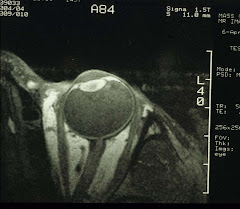
News today: "...a fish with cloudy eyes is an indication that it is well past its prime. Your fish should also have bulging eyes. Eyes that are sunken reveal a dehydrated fish, which means it spent more time on ice than in the water before you made your purchase."
Cloudy eyes = cloudy corneas = corneal edema = dead endothelium
Yep, not fresh enough for people with more sensitive palate.
Fish covered with ice, not on ice, are rarely dehydrated. Those with sunken eyes probably smell too fishy already, they should be avoided indeed.
Friday, February 7, 2014
Thursday, January 23, 2014
GlassesOff app
![]() |
| http://www.glassesoff.com/ |
Source: here
Friday, January 17, 2014
Google contact lens
Google is developing smart contact lenses that measure the glucose levels in diabetics' tears.
Comment: All contact lenses have the potential of impeding corneal access to air/oxygen. This changes glucose metabolism big time. Also, the tear turnover rate may vary from individual to individual. Much remains to be done before this smart lens becomes practical.
Saturday, January 11, 2014
A protein safeguards against cataracts
![]() |
It is this trigger mechanism that the team headed by Buchner and Weinkauf uncovered now. When a cell is exposed to stress, for instance when subjected to heat, phosphate groups are attached to a specific region of the protein. The negative charges of these phosphates break the links between the subunits and the large complexes consequently disintegrate into numerous smaller ones of only six or twelve subunits each. As a result of this breakup, the regions at the ends of the complexes become more flexible allowing the molecules to dock up with different partners, thereby preventing them from clumping – the protective protein is now active.
Source: here
Thursday, January 9, 2014
Bioflourescence in fish
A new discovery reported on 1/8/2014:
"...a variety of fish living around coral reefs -- including sharks, rays, eels and lizerdfishes -- that exhibited bioflourescence [under blue light].
"So how do the fish recognize it? Many of them have yellow filters in their eyes, "possibly allowing them to see the otherwise hidden fluorescent displays taking place in the water," a news release from the museum of natural history said.
However,
"...the need for special technology to view what the website called weak fluorescence "casts doubt on the usefulness of the coloration in the fish's dimly lit natural environments."
"...a variety of fish living around coral reefs -- including sharks, rays, eels and lizerdfishes -- that exhibited bioflourescence [under blue light].
"So how do the fish recognize it? Many of them have yellow filters in their eyes, "possibly allowing them to see the otherwise hidden fluorescent displays taking place in the water," a news release from the museum of natural history said.
However,
"...the need for special technology to view what the website called weak fluorescence "casts doubt on the usefulness of the coloration in the fish's dimly lit natural environments."
[Source: CNN.com]
Tuesday, October 8, 2013
Nobel prize in physics 2013
(CNN ) - The Higgs boson, or the "God particle," which was discovered last year, garnered two physicists the Nobel Prize in physics on Tuesday, but it didn't go to the scientists who detected it.
Nearly 50 years ago, Francois Englert of Belgium and Peter Higgs of the United Kingdom had the foresight to predict that the particle existed.
Now, the octogenarian pair share the Nobel Prize in physics in recognition of a theoretical brilliance that was vindicated by the particle's discovery last year.
Well deserved. Congrats!!
Nearly 50 years ago, Francois Englert of Belgium and Peter Higgs of the United Kingdom had the foresight to predict that the particle existed.
Now, the octogenarian pair share the Nobel Prize in physics in recognition of a theoretical brilliance that was vindicated by the particle's discovery last year.
Well deserved. Congrats!!
Thursday, August 1, 2013
AMD stem cell trial began
World's 1st iPS cell clinical study for regeneration of retina begins
TOKYO — 8/1/2013The world’s first clinical study using stem cells harvested from a patient’s own body began Thursday. A government committee last month approved proposals for the tests, which will be jointly conducted by the Riken Center for Developmental Biology and the Institute of Biomedical Research and Innovation (IBRI) Hospital in Kobe.
Health Minister Norihisa Tamura signed off on a proposal by two research institutes that will allow them to begin tests aimed at treating age-related macular degeneration (AMD), a common medical condition that causes blindness in older people, using “induced Pluripotent Stem (iPS) cells”.
Subscribe to:
Posts (Atom)