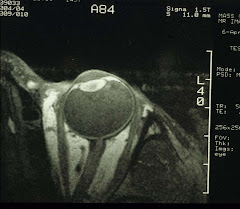
In the deep caves of Madagascar, absolute darkness led to the development of eye-less creatures, hence this:
Blind Shrimp Flee from Blind Cave Fish
Monday, July 19, 2010


Thursday, June 17, 2010
10.14 EYE in Chicago
 EYE is a three-story tall eyeball sculpture that artist Tony Tasset will install in Chicago's Pritzker Park next month. You can see it, and it can see you, until the end of October. Some may find it creepy - Tasset acknowledged, calling it "surrealist-noir."
And the reason why it is a blue eye? Well, it is modeled after the artist's own eye. Is it anatomically correct? Most likely not. Would have been an educational opportunity if there is a door opening into a world of the intricate inner structure of the eye. One such model used to locate on the first floor of Singapore National Eye Centre. It may still be there. Check it out.
Wednesday, June 2, 2010
10.13 Bob Cousy on vision
 Bob Cousy in his heyday, now 81
There is a fascinating comment by Bob Cousy that appears in Boston Globe [6/2/2010]:
“Vision, I think, for a point guard, is the most important thing. I was constantly being told I had eyes behind my head. It would seem that way to people who didn’t know that much about basketball who couldn’t believe that I could see things I could see. It’s exceptional peripheral vision.
“People who have tunnel vision don’t usually become point guards. That happened with [Chauncey] Billups here before they traded him. I think it was the only thing [Rick] Pitino ever asked me. I didn’t think Billups would make a good point guard because he would penetrate and then run into people. Billups proved me and Pitino both wrong, but I still don’t see him as a great creator in the vein of Rondo.’’
Rondo is of course the 6-1, 175-pound Celtic point guard Rajon Rondo. And here we go again: Game 1 of NBA Championship - June 3, 2010.
Beat LA!!
Saturday, April 24, 2010
10.12 Watch it at your own risk
 3D TV has finally arrived. In an apparent attempt to ward off potential lawsuits, Samsung has publicized the dangers of 3D TV watching:
 Photosensitive Seizure Warning and Other
CNN has an analysis: "Can 3-D movies, television make you sick?". In part, it says
In addition: As for long-term effects of watching 3-D television instead of regular television, no one knows for sure because it's too new. ...is concerned about serious consequences for children who watch 3-D television for long periods of time -- 'a continuous abnormal stimulus may possibly have long-term effects that are yet to be studied'...
So 3D TV watching can be hazardous to your health. Does it really? More research, please.
Wednesday, February 17, 2010
10.11 Avatar
 According to China Daily [see here], a middle-aged female developed acute angle-closure glaucoma after attending a 3D showing of the movie Avatar. Presumably, pupil dilation induced by the dark environment for a lengthy period of time precipitated this attack. Curiously, however, the patient must have been staring at the bright movie screen; this, by itself, should have caused pupil constriction unless totally negated by the Polaroid glasses worn for the 3D effect. Unfortunately, no experimental data are available for a reasonable explanation.
Ultimately, the deciding factor is the structure of the angle in the eyes of each individual. A patient with extremely narrow angle will have a higher risk that often can be confirmed with the darkroom test. Intermittent narrow angle glaucoma cases can be examined with the darkroom prone-position test in which the patient stays for 45 min without going to sleep. And the IOP measured immediately after. An increase of 8 mm Hg is considered positive.
Not only the movies, 3D TVs are rapidly moving into the consumer products arena. The common complaint of asthenopia owing to the contraction of medial recti can be resolved with the incorporation of base-out prisms in the 3D glasses. Strangely, no manufacturers have bothered with this implementation thus far even though the cost is minimal.
A recent report of stroke/death of a hypertensive man in Taiwan [see here] after watching Avatar is most likely coincidental. It could have been from seeing any exciting movies, not necessarily the 3D effect per se; although medical issues do await further investigation.
All new technologies will have unintended side-effects, real or imagined, e.g., the much disputed correlation between cell phone use and brain tumor (there is none, BTW). The introduction of the pseudo-3D visual world to the populace is no exception. This may spur some much-needed research. Very simply put: who wouldn't want to enjoy 3D in both comfort and safety.
Sunday, January 17, 2010
10.10 Alzheimer's eye test
 [Source: http://lancastria.net/blog/?p=1794]
The headline of The Daily Mirror "High street eye test for Alzheimer's within five years" (Jan 14, 2010) is so tantalizing that prompts a further reading:
"A test for Alzheimer's could be carried out by shop opticians within five years. Scientists have found a way to detect the disease before any symptoms emerge during eye exams.
"By putting harmless fluorescent dye on the retina, they can spot dying cells - an early indication of Alzheimer's.
"The technique could end the need for costly MRI scans.
"Prof Francesca Coredeiro, of University College London, said: "Few people realise the retina is a direct, albeit thin, extension of the brain." and "It's entirely possible a visit to a high-street optician to check your eyesight in five years will also be a check on the state of your brain."
Wow, that is certainly progress; although a careful reading of the original research paper [here] raises some issues:
1. The high-street optician must own and be proficient in operating a confocal scanning laser ophthalmoscope to take the pictures of the retina through dilated pupils plus knowledge in interpreting the images;
2. To put the "harmless fluorescent dye on the retina" requires an intravenous injection of the dye, much like fluorescein angiography; the widely reported eye drops approach simply does not work; and
3. What evidence is there to support death and necrosis of the retinal photoreceptors in mice predates brain cell deaths, and even if true, does that apply to Alzheimer's in humans.
In five years? Maybe not.
Thursday, December 31, 2009
Happy New Year !!
 A Happy New Year to All !!
(When you pop-open the champagne bottle, make sure the cork does not hit anyone in the eye .)
Subscribe to:
Posts (Atom)