Tuesday, May 22, 2012

12.12 It never fails

The ring of God

News from Japan [Japan Today 5/22/2012]:

At least 74 people sought help for eye problems at eye clinics in 18 prefectures across Japan after observing the annular solar eclipse on Monday, the Japanese Ophthalmological Society reported on its website Tuesday.

Doctors and education officials had warned of eye injuries from improper viewing beforehand. Education Minister Hirofumi Hirano demonstrated the use of eclipse glasses in a televised news conference on the weekend.

The society said most of the complaints were solar retinopathy due to not properly using special protective glasses. Of the 74, 16 were children younger than 12.

The next solar eclipse comes on May 20, 2016. Be prepared this time, people.

Friday, May 4, 2012

12.11 Vitamins E, C no help against vision disorder

"In May 2009, a study was published in the journal Opthalmology which broadened the field of eye-friendly foods and nutrients. The following nutritional components were associated with a slowing of the progression of AMD [age-related macular degeneration]:

Vitamins C and E
Zinc
Lutein & Zeaxanthin (antioxidant carotenoids)
DHA & EPA (fatty acids found in fish)"
[quoted from here]

Now a new study, claiming C and E have no protective effect at all, appears in the same journal:

"This latest study is the longest-running one to test vitamin E for eyesight in men, and the first to try out vitamin C alone, said lead researcher William G. Christen, of Brigham and Women's Hospital and Harvard Medical School in Boston. It found no benefits of either vitamin in older men who took supplements for eight years."
[quoted from here]

As usual, the field of epidemiology is full of contradictory results. The latest study recruited 14,000 male physicians, a "well-nourished bunch" as the authors noted. Apparently, no one has the last words yet.

Monday, April 30, 2012

12.10 Rainbow in the eye


Rainbow colors in the tear film indicate that it is rich with lipids that are required to keep the aqueous portion of the tears from evaporating too quickly [Source: TearScience] 

What does this mean? Simple: Presence of the rainbow colors indicates the oily film is preventing water in the tear fluids from escaping into air, so the eyes stay moist. On the other hand, lack of this protection leads to a common form of dry eye.


Tuesday, April 17, 2012

Kang Young Woo, PhD (1944-2012)

Blinded by retinal detachment from a soccer accident while in high school, Dr Kang had overcome all odds and become the first ever blind Korean to have received a PhD degree in the US. This was at a time when the blind had little choice except to become a masseur or a fortunate teller. His lifetime work as the founder of the EREF International was to champion the cause of the visually disabled. Among other endeavors, he had organized low vision conferences held in Seoul and founded a school for the blind, called Angels' Heaven, also in Seoul.

He was only 68 when he passed leaving behind Mrs Kang who volunteered to read lessons to him when they were both still in high school, and two sons, one a corneal surgeon and the other a gov't lawyer.

Dr Kang's was a full life, much too short, however.

Thursday, March 15, 2012

12.9 Basketball-sized eyes

[Left] The caption reads: "Colossal squid corneas—relatively small parts of the animal's basketball-size eyes (file picture). Photograph by Marty Melville, Getty Images." - National Geographic Daily News (3/15/2012)

This is incorrect, both appear to be the crystalline lens, not the cornea at all.

The colossal squid (Mesonychoteuthis hamiltoni) has basketball-sized eyes - "10.6-inch-wide", and someone is trying to figure out why eyeballs of this size are needed to see at an depth of the ocean where it is essentially pitch-dark.

The answer, according to the report seems:

"The team's models [developed by Dan-Eric Nilsson et al at Sweden's Lund University] revealed that, what the colossal and giant squid's supersize pupils and retinas lacked in close-up vision they made up for with extreme farsightedness. The cephalopods are fine-tuned to spot very large objects at a distance—such as the sperm whales that prey on the squid.

"Still, no matter how large the eye, or how big the object being seen, darkness presents a visual problem.

"With their great light-gathering capacity, squid eyes are able to detect even a faint glow the equivalent of a football field away, the study found.

"Not coincidentally, when a sperm whale is on the move, it disturbs tiny bioluminescent life-forms, creating a faintly glowing trail in the whale's wake—and giving squid an unintentional warning sign."

Hmm... the squids "lacked in close-up vision they made up for with extreme farsightedness"?

To spot tiny bioluminescence a football field away, emmetropic vision, i.e., 20/20 or better, is of course needed. If they are extremely farsighted, then accommodation is required, and if they don't have "close-up vision", then all bets are off. It'll be blurry as heck...

Tuesday, March 13, 2012

12.8 Farewell, Mr Spock?

News today (see here):

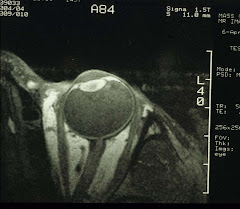
Brain scans of NASA astronauts who were in space for more than a month revealed potentially serious abnormalities that could set back plans for longer deep space missions, according to a US study published Tuesday.

Researchers from The University of Texas Medical School in Houston scanned the eyes and brains of 27 astronauts who had spent an average of 108 days in space, either on space shuttle missions or aboard the International Space Station.

They found that those who spent more than a month in space were more likely to suffer from intracranial hypertension -- a potentially serious condition that occurs when pressure builds within the skull.

The symptoms included excess cerebral-spinal fluid around the optic nerve in 33 percent of the astronauts studied, while a fifth showed a flattening of the back of the eyeball, which affects the ability to focus, research published in the journal Radiology showed.

OK, what about female astronauts?

Wednesday, March 7, 2012

12.7 Not again!

[Textured lines in a train station in Japan]

SAITAMA [3/7/2012] — A visually-impaired man who fell from a platform onto train tracks in Kawagoe, Saitama Prefecture, was hit and killed by a train, police said Wednesday.

According to police, the incident occurred at 1 p.m. on Tuesday. The man, who has been named as Akio Hashimoto, 62, was visually impaired and walked with a cane, Fuji TV reported.

Following the incident, station staff reviewed security camera footage and found that Hashimoto had been following textured paving blocks that act as a guide for the visually impaired, when he seemed to lose track of them. Searching for the correct route, station employees say the man fell off the platform onto the tracks and was subsequently struck by a train, Fuji reported.

Police say Hashimoto had 10% vision and worked as a masseur.

No bystanders there to help?