Friday, November 13, 2009

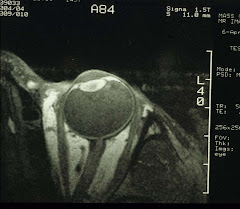
10.8 Peripheral hyperopic defocus

Recently, some diligent researchers have come up with a novel explanation of myopia progression in the human, i.e., the "peripheral hyperopic defocus".

In plain English, it means when you wear glasses to correct nearsightedness or more accurately the central vision, the side vision is actually still fuzzy with the clear focal points behind the eye (or being hyperopic, i.e., farsighted, by definition). This is illustrated in the picture here, in which the white arc behind the eye is the hyperopic focus. It is this blurriness at the retinal level that seems to cause the eyeball to grow or "elongate" in the anterior-posterior sense. Not only in the myopic eyes, potential myopic eyes also have the more prolate eyeball shape. So it would appear that the shape of the eyeball is predictive of myopia formation and progression.

With the new information,
(1) the instrument makers can develop new refractive devices;
(2) lens makers can design new spectacle and contact lenses;
(3) the doctors will have new myopia managing regimens to contemplate;
(4) the biochemists will propose and test new projects on the development of posterior sclera/choroid during myopization; and
(5) the drug makers can look into more targeted posterior pole growth inhibitors.

In other words, a whole new enterprise unveils right before our eyes. Naturally it remains to be seen if this defocus theory ultimately proves to be true.

Tuesday, October 13, 2009

10.7 Gordon Brown's eyes

Have you ever noticed that Mr Brown's left eye is slightly recessed and is in a down and out position?

He has lost his vision in the left eye from retinal detachment - after being kicked in the head while playing rugby at age 16. Several attempts at repairing this eye had failed. When the right eye started to show the same symptoms and signs of RD two years later, the re-attachment was quite successful.

A routine annual eye exam on Oct 10 reveals that Mr Brown's right eye has two small retinal tears. For now, ophthalmologists at Moorfield Hospital where Mr Brown was seen have decided to continue observation rather than perform an operation. Presumably, 3-7% of Brits walk around unaware of retinal tears in their eyes. Mr Brown insists that his eye sight has not deteriorated; although he does read texts with large prints.

Quite a few take-home lessons here:

(1) contrary to common belief, low vision in fact does not affect a person's capabilities;
(2) the need for regular eye exams is clear - once every two years as a matter of principle, once every year when necessary;
(3) not all retinal tears must be patched;
(4) RD from head trauma is not uncommon - with long latency as well; and most important,
(5) retinal tears do not affect central vision - patients must instead pay attention to appearance of photopsia and floaters.

Wednesday, October 7, 2009

10.6 Reading glasses and bank robbery

Guess what, now reading glasses are an accessory for committing a crime:

News from BROCKTON, MA, USA - Police are looking for a man who robbed a bank Monday (Oct 5, 2009) morning in Brockton.

The suspect, who was wearing reading glasses and a Red Sox hat, passed a note to the Community Bank teller demanding money, police said. The man fled from the Main Street bank in an unknown direction after taking money.

Police say the suspect was wearing a beige pullover, blue jeans and work boots. Anyone with information about this person is asked to call Brockton police at 1-(508)-941-0234.

Let's see, a male Caucasian with a pair of half-eyes suggesting he is 42 years-old with 20/20 distant vision. The glasses are apparently OTC, purchased for US$15 from a local drug store, probably one of the CVS Pharmacies. Most likely, these glasses are made with +1.25 to +1.50D lenses to be used for reading comfortably at 16 inches, if we know the height of the counter top at the bank, this robber's body height can be quickly estimated. On the other hand, the Boston Red Sox cap is not helpful, almost everybody has one.

Forensic optics can be fun, huh?

Thursday, August 13, 2009

10.5 LCA repair

After 2 years, the preliminary results of LCA (Leber congenital amaurosis) gene therapy are in [Aug 12, 2009].

This study is still ongoing at U of FL and UPenn (and other universities). The participants are a woman and two men between the ages of 21 and 24. After 12 months, the safety is maintained. More important is this:

"The tiny portions of the patients’ retinas that received gene therapy [RPE65] experienced restored function up to 1,000-fold during the day and 63,000-fold at night."

In other words, the patients have developed a preferential retinal locus at the injected (treated) area. The visual acuity will depend on the photoreceptor density, among other issues. And the field size will necessarily be limited to the locus. Still, it is a giant leap forward.

Let's hope this study continues to be successful.

Thursday, July 30, 2009

10.4 Blue-eyed rodent

Researchers at Univ of Rochester have discovered that Brilliant Blue G, a food dye, when injected IV can prevent secondary neuronal damages caused by an excess release of ATP into the spinal injury site.

The injection works only if it is done within 15 min after the injury and the skin turns blue for a while as a result.

The more interesting to us is the eyes now also appear blue (right). The pink hue of the paws, ears, nose, and the eyes (top left) is typical of the lack of pigmentation in this type of rats allowing the vascularity to show through.

Presumably then, a fair-skinned person, after consuming a large quantity of blue M&Ms, may develop dark blue eyes even if only briefly. The blue skin? We refer you to Star Trek (2009), Uhura's roomate (and Kirk's date) for more details.

Wednesday, June 24, 2009

10.3 Target: one million cases of cataracts

This is a news report on June 24, 2009:

来源:荆楚网 (楚天都市报 陈媛 田静欣 高翔 向清)

记者昨从湖北省卫生厅获悉,我省于近日启动“贫困白内障患者复明工程”,近万名患者可从中受益。  
今年,我国启动“百万贫困白内障患者复明工程”,计划利用3年时间,为100万名贫困白内障患者实施复明手术,湖北省今年的任务是9475例,每位患者将享受800元的费用减免。全省三级医院和大部分具备条件的二级医院都将成为项目医院。
昨日,中南医院开始接受手术报名,凡我省农业户口以及城镇下岗职工、低保、残疾人士等都可持相关证明到该院登记手术。
该院眼科主任蔡小军介绍,我国约有盲人1240多万,因白内障致盲人数约为699万,这其中又有15%的患者属于贫困阶层,无钱做手术。

Partial translation: "Hubei Province will soon institute a program, Cataract Vision Restoration for the Poor, and about 1 million patients will benefit. This is a 3-year program and for the current year, 9,475 patients will enjoy a $800 (about USD 100) discount for the surgery... It is estimated that there are 12.4 million blind in China. Of them, 6.99 million are cataract cases and 15% cannot afford to pay for the surgery [hence this program]."

Certainly a step in the right direction.

Tuesday, June 23, 2009

10.2 Blurred vision

Lies all well disguised, masses all hypnotized
Terror's all you hear, war won't make it disappear
Leader's teach us, everything we shouldn't be
everyday people, this is no Democracy!

(a song in support of the Iranian people, try http://blurredvisionmusic.com or here)