Now, 2008
 First, all sons and daughters, take your father out to dinner on Sunday.
 (The above is a fundus photo of optic neuritis, notice the blurred disc margin. This is not always seen, however. Image from meded.ucsd.edu.)
 The above is a T1-weighted coronal image of the brain after intravenous GdDTPA, a contrast agent, to provide enhancement of the lesion. And in this case, a hyperintense left optic nerve (on the right side of the image, the white spot next to the caption) suggesting a leaky optic nerve sheath resulting from, most likely, inflammation. In contrast, the right optic nerve shows no such enhancement. This clinches the diagnosis of left optic neuritis. A course of intravenous steroid treatment is then in order. Unfortunately for the patients, optic neuritis is often an early manifest of multiple sclerosis (MS):
 In fact, 15 years after the onset of optic neuritis, ca 75% of women and ca 34% of men will have developed MS (see above, the hyperintense areas) which is characterized by exacerbations and remissions of motor and/or sensory functions over a period of time. Conversely, up to 50% of MS patients will develop one episode of optic neuritis. Both types of patients are seen in the eye doctor's office.
 The spectra shown above were obtained on Days 98 (A), 147 (B), 189 (C), and 259 (D) of a longitudinal study. The volume of interest is exhibited in the MR images. The resonance at 2 ppm is NAA. (A) is the baseline. (B) and (C) reflect transient changes, chiefly a decrease in NAA. And (D) total recovery back to baseline as that in (A).
 Yes, everybody knows that: we all live in a magnetic field - the Earth. Its field strength is a mere 30-60 micro Tesla (depending on where you live). However, a large metal tube such as a submarine deep in the ocean can cause magnetic disturbances and is therefore detectable. Rumor has it that a certain U-Boat captain founded an NMR company, most likely inspired by his wartime experience evading MADs (magnetic anomaly detectors). A submarine can become electrically charged owing to the difference in the temperature of the upper and lower hull. This is enough to create a difference in salinity of the enclosing sea water, hence a dynamic electric field around "Das Boot". A stealth submarine will have to address this issue obviously. In NMR, shielding high-field magnets is a challenge even now. Incidentally, Mr Tom Clancy has much more on anti-submarine warfare in his classic "The Hunt for Red October" (which most people on Earth have already read):
 Back to the issue at hand: At some point in the not so distant future, the full potential of biological NMR will finally be realized. And it will be in the form of 4-dimensional (three spatial and one chemical-shift) NMR spectroscopy. In other words, imaging of, not just the water-protons, but the far more informative metabolites. The limiting factor is, yep, you've guessed it, the magnetic field strength.
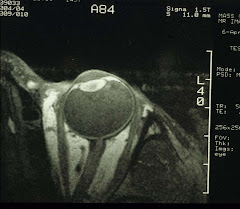
Top: Schematic diagrams of the lens. The two primary regions are the cortex and the nucleus. (Left): section through the anterior-posterior poles and (Right): section through the equatorial plane.
Bottom: A water-proton image, through the equatorial plane, acquired with a spin-echo pulse sequence with TE (echo time)/TR (repetition time) = 3.88/1000ms, a 126x128 matrix, and 32 averages. Image resolution was 40 x 40 x 500 micron.

Part 2. Chemical-shift 13C microscopy:
 At the bottom is a 13C spectrum acquired at 100.61MHz without proton decoupling - hence the multiplets of the biochemicals.
 (Source: http://www.ajnr.org/cgi/content/full/23/8/1387)
 It is then possible to obtain high-resolution MR images of the eye and water-suppressed proton spectra of the vitreous. Again, for the time being.
 (A 4.7-Tesla horizontal-bore superconducting magnet for small animals)
 The above is a 31P spectrum of normal rat lenses (age of the animals: 8-10 months). It shows low levels of S3P (sorbitol-3-phosphate), F3P (fructose-3-phosphate), and αGP (α-glycerophosphate), and relatively high levels of PCh (phosphorylcholine), Pi (inorganic phosphate), GPC (glycerophosphorylcholine), and ATP.
 And if the the diabetic rats are treated with an oral AR (aldose reductase) inhibitor to stop sorbitol production, then the spectrum normalizes. In fact, both S3P and F3P now disappear entirely.
 On the other hand, no mannitol is produced in lenses incubated in high mannose:
 Does this mean that mannose can be used as a sweetener for the diabetics? Perhaps. Mannose, in fact, does taste quite sweet. Although, as they often say: more studies are needed.
 Of course, there are numerous other ocular diseases that can be examined with NMR. For example, the much dreaded bacterial endophthalmitis after cataract surgery. In rabbits, intraocular Streptococcus pneumoniae caused appearance of lipids in the vitreous, suggesting a breakdown in the blood-ocular barrier:
 On the left are proton spectra of the normal eye/vitreous dominated by the lactate resonance (at 1.35ppm). The infected eye/vitreous shows, in addition to lactate, methylene (1.15ppm) and methyl (0.83ppm) groups of lipids, over a span of 2-4 days. By the 10th day, the eye becomes phthitic.
 One wonders if both Felix Purcell (1912-1997) and Edward Bloch (1905-1983) had experimented with magnets (see above) when they were little. They did, however, share the Nobel Prize in Physics in 1952 for independently creating experiments for the observation of NMR (nuclear magnetic resonance).
| Particle | Spin | wLarmor/B s-1T-1 | |
| Electron | |||
| Proton | |||
| Deuteron | |||
| Neutron | |||
 (From: teaching.shu.ac.uk/hwb/chemistry/tutorials/molspec/nmr1.htm)
 (Note: No Bruker share-holders here)
 Before insertion, it needs to be optimized by using tuning and matching rods with the aid of an oscilloscope. Tuning is simply to make sure the probe is set to the frequency of interest. And matching is to ensure the impedance is equal to the external electronic circuitry so that maximal power can be transferred. These two operations are actually inter-related:
 Shimming is an art, its purpose is to maximize the magnetic field homogeneity which greatly affects spectral resolution. Some "NMR jocks" are known to take extraordinarily long time (e.g., forever) to shim the magnet - to perfection. And a lot of them know how to read the FIDs even before FT. The resulting spectra are often strikingly well-resolved. NMR jocks are a special breed. Much like computer hackers, NMR jocks also survive on pizza and coke, except the food and drink are paid for with cash, as their credit cards are usually erased by the magnets. (Try and explain this to the pizzeria owners.)
 (The visual pathway - looking from the base of the brain)
 (From socialfiction.org)